Jenna
The CEO’s Baby Girl: A Workplace Reverse Harem Romance (Age-Gap Billionaire Obsessions)Jenna is the first person in the available narrative to look past Ariella Monroe’s visible transformation and challenge the meaning Ariella assigns to it. In Chapter 8, “Jenna’s Warning,” she becomes an external moral and emotional counterweight to Dominic Vale’s control: where Ariella experiences possession as exhilarating and awakening, Jenna sees the possibility of erasure. Her importance lies less in any power to stop the relationship than in her insistence that Ariella recognize what is happening before surrender becomes indistinguishable from loss of self.
Identity and Introduction
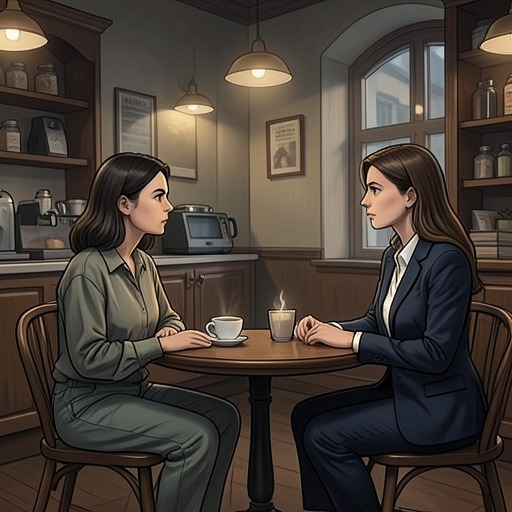
Jenna enters the scene at a quiet coffee shop that feels watchful rather than intimate. She arrives seven minutes late, wearing oversized sunglasses and a red scarf wound tightly around her throat; after removing the sunglasses, she studies Ariella with an unreadable expression. The details give her entrance a guarded quality, as though she has come prepared both to observe and to protect herself. Her first response to Ariella is that she looks different, and Ariella confirms that the change is internal as well as visible by saying that she feels different.
Jenna quickly identifies the concealed subject of the meeting. When Ariella pretends not to know whom she means, Jenna names Dominic Vale directly and characterizes him as a CEO, a billionaire, a control freak, and a man with a God complex. The description compresses public status and private danger into one accusation: Dominic’s wealth and authority are not neutral background details for Jenna, but part of the structure that makes his control difficult to resist. Jenna also notices the collar Ariella is wearing. She recognizes it as a designer collar, but the luxury of the object does not make its implication less troubling; instead, its fashionable appearance reveals how domination can be disguised as refinement.
Warning and Knowledge
Jenna’s warning gains force because she does not present herself as an uninvolved moral critic. She asks Ariella whether she knows what happened to the last girl, and Ariella’s breath catches before she can answer. Jenna’s narrowed eyes and terse follow-up make clear that this is not casual gossip. The unidentified former woman represents a pattern that Jenna believes Ariella has not yet understood: women can become intensely invested in Dominic and then be gone the next day. Jenna later clarifies that she is not speaking of women in the abstract or merely describing ordinary romantic failure; she distinguishes the missing or discarded women from those who become obsessed with Dominic and then disappear from his life.
At the same time, Jenna denies that her warning is simple judgment. She says that she has been there and that everyone has wanted someone too much. This admission places her closer to Ariella than her accusation initially suggests. Jenna understands the seduction of excessive desire from experience, yet she insists that Ariella’s situation exceeds desire. Her language shifts from attraction to consumption, portraying Dominic’s influence as something that takes in and uses the person who approaches it. The contrast between Ariella’s glow and the source of that radiance is central to Jenna’s reading: Ariella may look illuminated, but Jenna sees fire rather than sunlight, and fire carries the consequence of burning.
Relationship to Ariella Monroe
Jenna addresses Ariella with directness that repeatedly collides with Ariella’s defensive loyalty to Dominic. Ariella first minimizes the connection, then rejects Jenna’s interpretation, insisting that Dominic is not the kind of man Jenna describes. Jenna does not answer this denial by offering proof or by trying to overpower Ariella; instead, she asks whether Ariella feels safe with him. The question moves the conversation from reputation and appearance to Ariella’s immediate bodily and emotional condition.
Ariella’s answer exposes the conflict Jenna is trying to name. Ariella admits that she feels owned, but adds that the feeling is not bad. For Ariella, ownership has become compatible with aliveness; she feels more alive than ever. Jenna hears the same statement as a danger signal. She responds that this is exactly what someone says before being broken so completely that the person no longer remembers who she was before. Her response does not deny Ariella’s sensation of vitality. Rather, it challenges the assumption that intensity proves safety. Jenna treats Ariella’s pleasure and heightened life as potentially inseparable from a process of psychological disintegration.
The scene therefore establishes a protective but strained relationship between the two women. Jenna tries to preserve Ariella’s capacity for self-recognition, while Ariella is already speaking from within Dominic’s vocabulary of possession. Jenna’s concern is urgent precisely because Ariella does not experience herself as simply victimized. The danger, as Jenna sees it, is not only that Dominic may hurt Ariella, but that Ariella may interpret the loss of autonomy as fulfillment and resist anyone who calls it harm.
Actions, Conflict, and Consequences
Jenna’s principal action is confrontation. She observes Ariella’s changed appearance, identifies Dominic as the cause, points to the collar, invokes the fate of the previous girl, distinguishes desire from consumption, and asks the decisive question of safety. Each step narrows the distance between the polished surface of Ariella’s new life and the possibility of coercion beneath it. Jenna does not offer a complete account of Dominic’s past, and the available scene does not reveal what happened to the last girl. That withheld information functions as a threat without becoming a settled fact beyond Jenna’s warning.
Ariella’s abrupt physical reaction shows that Jenna’s words have reached a vulnerable point. After admitting that she feels owned, Ariella stands suddenly, with her pulse thundering in her ears. Her movement ends the immediate exchange rather than resolving it. Jenna has not persuaded Ariella to leave Dominic, but she has introduced an alternative interpretation of Ariella’s experience: ownership may be a prelude to being broken, and apparent radiance may be the visible heat of a destructive force.
Narrative Role and Significance
Jenna functions as a warning figure and a reality check within the developing relationship between Ariella and Dominic. She is not presented as omniscient, and her evidence remains partial, but her perceptiveness gives the chapter its ethical pressure. The coffee shop’s eerie silence, her guarded arrival, and her scrutiny of the collar all frame the conversation as an attempt to make a hidden structure visible. She recognizes that the relationship is not merely a private romance because Dominic’s authority, Ariella’s altered self-presentation, and the history of another woman have transformed desire into a question of ownership and identity.
Her role also creates a sharp contrast between two understandings of Ariella’s change. Ariella reads her new state as awakening, claiming that she feels more alive than she has ever felt. Jenna reads the same radiance as fire. That unresolved contrast gives Jenna lasting narrative significance even within this brief appearance: she supplies the language of danger before Ariella is ready to accept it. By asking whether Ariella feels safe and by warning that she may one day forget who she was before Dominic, Jenna protects the possibility that Ariella’s present exhilaration can still be questioned rather than treated as proof that surrender has become freedom.